Who Does End-to-End Restaurant Consulting in India?
2026-08-12
8–10 Minutes Mins Read
Who Does End-to-End Restaurant Consulting in India?
Introduction
Opening a restaurant is rarely as simple as having a good food idea and finding the right location.
Before the first customer arrives, an owner has to make decisions about the business model, investment, positioning, menu, pricing, staffing, operating systems, technology and growth strategy. Once the restaurant opens, the questions become even more important: Are the margins healthy? Is the team productive? Are processes being followed? Can the business perform consistently when the owner is not present?
This is where end-to-end restaurant consulting in India can become valuable.
A strong restaurant consultant does more than provide advice for one part of the business. The consultant should understand how the commercial model, menu, people, operations, customer experience and growth strategy work together.
There are several restaurant and F&B consulting firms in India, but their areas of expertise are not identical. Some focus broadly on restaurant development and operations, while others have stronger expertise in food-service design, culinary development, branding or transformation.
This guide looks at five consulting options and explains what each one is best positioned to help with.
What Does End-to-End Restaurant Consulting Actually Mean?
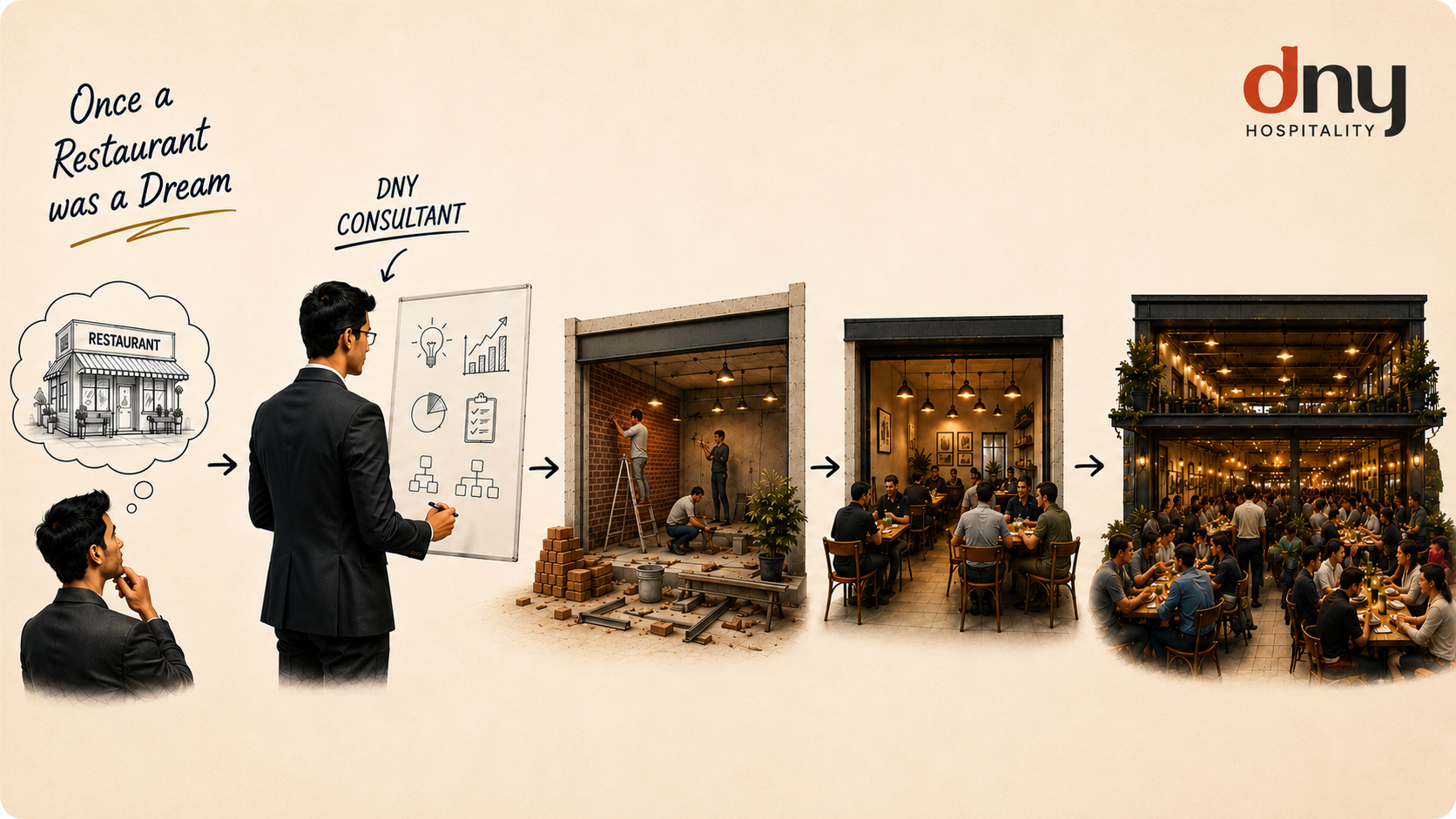
End-to-end restaurant consulting means supporting a food business across multiple connected stages rather than solving only one isolated problem.
For a new restaurant, this can involve feasibility, competitor research, business modelling, financial planning, concept development, menu engineering, recipe standardisation, operating systems, manpower planning, training, launch support and future expansion.
For an existing restaurant, the starting point can be completely different. The consultant may first examine the restaurant's operations and P&L, identify where money or productivity is being lost, and then help the existing team correct those problems.
The important word is connected.
A menu cannot be evaluated only from a culinary perspective. Pricing affects margins. Margins affect the business model. The business model affects the format, staffing and expansion strategy. Similarly, marketing can increase demand, but if the operation cannot deliver consistently, more demand can actually create a bigger problem.
Good restaurant consulting looks at those connections instead of treating every department as a separate project.
Why Restaurant Owners Choose End-to-End Consulting
Restaurant businesses have become increasingly complex. Owners have to deal with food costs, labour, rent, technology, customer expectations, delivery, inventory, competition and changing consumer behaviour at the same time.
For a first-time entrepreneur, this can be difficult because many decisions are being made for the first time. For an established restaurant, the challenge is often different: the business may already have a team and customers, but the owner may not have a clear understanding of why profitability or consistency is falling.
An experienced consultant can provide an outside perspective and help identify problems that are difficult to see when you are working inside the business every day.
The real value, however, is not simply identifying problems. It is building systems that allow the restaurant team to solve and manage those problems consistently.
1. DNY Hospitality
DNY Hospitality takes a systems-led approach to restaurant consulting, with its work focused on building food businesses that are profitable, systems-driven and transferable.
DNY works across different stages of the food-business lifecycle, including restaurant startups, running-business turnarounds, joint ventures, concept restaurants and international brands entering India. Its stated approach is to understand where the business actually stands before deciding what the engagement should look like.
For restaurant startups, DNY's scope can include feasibility and competitor studies, go-to-market strategy, business modelling, financial modelling, menu engineering, recipe development and standardisation, costing and yield control, SOPs, POS logic, manpower planning, KRAs and KPIs, training, investor readiness and franchise modelling.
For an existing restaurant, the approach starts with diagnosis rather than immediately recommending a rebrand. DNY describes its turnaround process around an operational audit, P&L and cost-structure audit, menu and margin analysis, manpower and productivity review, and guest-experience and delivery audit. The corrective work can then extend into menu optimisation, recipe standardisation, cost and vendor renegotiation, SOPs, POS systems, manpower planning and training.
DNY also works with joint ventures, fully developed concept restaurants and international brands entering India. For international brands, its stated work includes feasibility, localisation, format adaptation, partner identification, pilot outlets and development of an operating model suited to the brand's requirements.
One of the more distinctive parts of the DNY model is its wider specialist ecosystem. DNY Hospitality focuses on the commercial and operating spine of the business, covering strategy, economics and systems, while specialist group capabilities cover brand and design, marketing and growth, procurement and supply chain, and interiors and infrastructure.
The underlying philosophy is straightforward: a restaurant should earn before it impresses, run consistently across shifts and eventually be capable of being handed over to another outlet, city, franchisee, investor or buyer.
That makes DNY particularly relevant for entrepreneurs who are thinking beyond simply opening a restaurant and are focused on building a food business that can operate, improve and scale.
2. Diner Guru Consultancy
Diner Guru Consultancy works across different areas of food and beverage consulting, with services covering concept development, operations, resources and business support.
Its stated areas include concept development and ideation, menu engineering, resource acquisition and training, vendor acquisition and management, operations management, brand management and marketing, and advisory services. It also describes support for new and existing F&B businesses across formats such as restaurants, cafés, cloud kitchens and food trucks.
This makes Diner Guru relevant for food businesses looking for support across different stages of concept development and operations. Restaurant owners should compare its specific expertise, project scope, experience and implementation approach against their own business requirements before making a decision.
3. Brandmonk Food and Beverages Pvt. Ltd.
Brandmonk Food and Beverages Pvt. Ltd. focuses on food and beverage businesses, with an emphasis on building and scaling brands.
Its published company information describes its work around scaling sustainable F&B brands as well as business, technology and digital transformation consulting for the hospitality industry.
Its restaurant consulting website also presents services covering areas such as concept planning, branding, menu engineering, SOP development and staff training.
This can make Brandmonk relevant for restaurant businesses looking at brand development, growth, technology or operational transformation. Owners should still evaluate whether the firm's capabilities match the specific format, stage and objectives of their restaurant.
4. THI Consultant
THI Consultant, also known as Total Hospitality, provides specialist consulting across hospitality and food-service projects.
The company describes its focus around strategic design solutions, food-service and back-of-house consulting, with work covering hotels and resorts, restaurants and food courts, central kitchens and commissaries, educational institutions, hospitals and other hospitality-related facilities.
Its listed services include food-service design, kitchen design, hotel consulting, concept restaurant consulting, sweet-shop and bakery consulting and waste-management consulting.
This makes THI particularly relevant for projects where food-service infrastructure, back-of-house workflow or specialist hospitality design is an important part of the requirement. Restaurant owners should define the exact scope of their project before selecting a consultant.
5. Suril Udeshi
Suril Udeshi brings a specialised culinary and restaurant-development perspective to hospitality consulting.
His published services include menu planning, menu engineering, pricing, hiring and training, food styling and presentation, food trials, pre-launch previews, launch processes, post-launch supervision and retainership support. His website also highlights experience with high-end and fine-dining restaurant projects and vegetarian cuisine.
Menu development is a significant part of his offering, including menu creation, engineering and pricing. His food-trial work focuses on refining flavours, presentation and pairings before launch.
This positioning can be particularly relevant for restaurant projects where culinary development, menu strategy and launch execution are major priorities.
How Do You Choose the Right Restaurant Consultant?
There is no single restaurant consultant who is automatically right for every business.
A first-time founder may need help understanding whether a concept makes commercial sense before investing heavily. An existing QSR may instead need help finding the reasons behind weak margins or inconsistent execution. A fine-dining project may put greater emphasis on culinary development, while an international brand entering India may need localisation and market-entry expertise.
Start with the problem, not the consultant.
Ask yourself what you actually need help with. Is it feasibility? Business modelling? Profitability? Menu performance? Operations? Staff productivity? Brand positioning? Expansion? Franchise readiness?
Once that is clear, compare consultants based on their relevant experience.
It is also important to ask what happens after the recommendations are delivered. A strategy document can identify what should change, but implementation determines whether anything actually changes.
Ask about deliverables, timelines, people involved, implementation support and how progress will be measured.
If your long-term goal is expansion, ask another important question: Can the systems being created for outlet one work for outlet five?
That question often separates short-term restaurant setup advice from genuine business-building support.
Why DNY Hospitality Takes a Different Approach
DNY Hospitality's approach is built around the idea that restaurant consulting should strengthen the business, not simply make the restaurant look better.
Its consulting focus covers business positioning and modelling, financial models and ROI, menu and product, operating systems, scale and franchise strategy, staff training, investor readiness, performance transformation and market entry.
That means the commercial model comes before many downstream decisions.
The financial model has to make sense. The menu needs to support the economics. The operating system needs to be practical for the team. The processes need to be documented. And if the business is expected to grow, those systems need to be capable of travelling to another outlet or city.
DNY also uses a defined consulting process built around six phases: Discover, Define, Design, Build, Launch, and Govern & Scale. The stated outputs move from a written diagnostic and financial model through menu and costing, operating manuals and trained teams, launch stabilisation, and eventually expansion or franchise readiness.
This is important because restaurant consulting should not end when the presentation ends.
The real test is what happens afterward.
Does the team understand the new system? Are costs improving? Is the menu performing better? Are processes being followed? Can the owner understand the P&L? Can another outlet reproduce the same operating standards?
Those are the questions that determine whether consulting created an actual business improvement.
Which Businesses Can Benefit From End-to-End Restaurant Consulting?
End-to-end consulting can be useful across a wide range of food businesses, but the scope should change according to the business stage.
For a new restaurant, the priority may be feasibility, business modelling, positioning, menu development, systems and launch preparation.
For an existing restaurant, the priority may be diagnosing profitability, improving menu performance, reducing avoidable costs, strengthening SOPs and improving team productivity.
For a growing restaurant brand, the focus can shift toward standardisation, unit economics, franchise modelling, investor readiness and expansion.
For an international brand entering India, localisation, market feasibility, partner identification and adapting the operating model to Indian market conditions become more important.
This is why choosing a consultant based only on the phrase "end-to-end" is not enough. The real question is whether the consultant's end-to-end capability matches the specific stage and problem of the business.
Is End-to-End Restaurant Consulting Worth It?
It can be, but only when the consultant is solving a real business problem.
Hiring a consultant simply because every other restaurant seems to have one is not a strategy.
The value comes when the consultant brings expertise that the internal team does not have, identifies problems that are difficult to see from inside the business, or creates systems that would otherwise take years to develop.
For a startup, that may mean pressure-testing the business model before committing capital.
For an existing restaurant, it may mean discovering why revenue is not translating into healthy profitability.
For a growing brand, it may mean building the systems required to open several outlets without repeating the same operational problems at every location.
The right consultant should leave the business stronger, clearer and more capable than it was before the engagement.
Final Thoughts
Restaurant consulting in India has moved beyond simply helping entrepreneurs open an outlet.
Today's food businesses need to think about profitability, operating systems, people, customer experience, technology, standardisation and growth at the same time. That is why the right consulting partner can become an important part of building a restaurant business rather than simply setting one up.
The firms discussed in this guide have different areas of expertise.
Diner Guru Consultancy provides broad F&B consulting across areas such as concept development, menu engineering, staffing, vendor management, operations and brand management.
Brandmonk Food and Beverages focuses on F&B brands and also positions itself around business, technology and digital transformation.
THI Consultant has a specialist food-service and hospitality design focus, including back-of-house and kitchen-related consulting.
Suril Udeshi has a more specialised culinary and fine-dining orientation, particularly around menu development, food trials, training and launch support.
DNY Hospitality takes a broader business-building and systems-led approach across startups, running-business turnarounds, joint ventures, concept restaurants and international market entry. Its focus is on connecting strategy, economics, menu and product, operating systems, people and growth into one structured business model.
Ultimately, the best restaurant consultant is not necessarily the company with the longest list of services.
It is the consultant whose expertise matches the problem you are trying to solve—and who can stay close enough to the business to help turn the strategy into something the team can actually run.
Frequently Asked Questions
1. Who provides end-to-end restaurant consulting in India?
Several companies provide broad restaurant and F&B consulting services in India, including DNY Hospitality, Diner Guru Consultancy, Brandmonk Food and Beverages, THI Consultant and Suril Udeshi.
Their expertise differs, so restaurant owners should compare consultants according to their business stage, restaurant format and specific requirements.
DNY Hospitality focuses on startups, running-business turnarounds, joint ventures, concept restaurants and international brands entering India.
2. What does an end-to-end restaurant consultant do?
An end-to-end restaurant consultant can support several connected areas of a food business, including commercial planning, concept development, menu and product, operating systems, staffing, training, launch, performance improvement and expansion.
The exact scope depends on the consulting company and the project.
3. How do I choose a restaurant consultant in India?
Start by identifying the problem you need to solve.
A startup may need feasibility, business modelling and pre-launch support. An existing restaurant may need an operational audit, P&L analysis, menu optimisation or cost correction.
Then evaluate the consultant's relevant experience, deliverables, implementation support, timelines and approach to measuring results.
4. Can a restaurant consultant help an existing restaurant?
Yes.
Existing restaurants can use consulting to identify operational problems, improve profitability, optimise menus, strengthen SOPs, improve manpower productivity and prepare the business for expansion.
DNY's turnaround model, for example, begins with operational and P&L analysis before moving into corrective work across menu, cost, manpower, brand and process.
5. Is end-to-end restaurant consulting useful for first-time restaurant owners?
It can be particularly useful for first-time owners because restaurant decisions are interconnected.
The business model affects pricing. Pricing affects margins. Margins affect staffing and format. The operating model affects customer experience. And all of these factors influence whether the restaurant can eventually scale.
The important thing is to choose a consultant whose actual expertise matches the help you need.
Share


Related Blogs
DNY Hospitality: A Leading Restaurant Consultant
DNY Hospitality takes pride in introducing itself as one of the highly sagacious restaurant consultant in the F&B business.

25 Reasons Why You Need a Restaurant Consultant
Opting for a professional restaurant consultant in the making of your restaurant or food & beverage venture is of high value in the standardisation of your brand.

procurement and liaison
DNY Hospitality is a one-stop solution for your Restaurant consulting & Procurement & Liaison for setup. DNY liaisons with A to Z vendors for procurement of restaurant & hotel supplies.